Black-capped Chickadee
Poecile atricapillus
The wishlist bird — and the one that came home.

When Rita was a kid on Toronto Island, she fed black-capped chickadees from her open palm — sunflower seeds, a bird light as nothing landing for a second and choosing to stay.
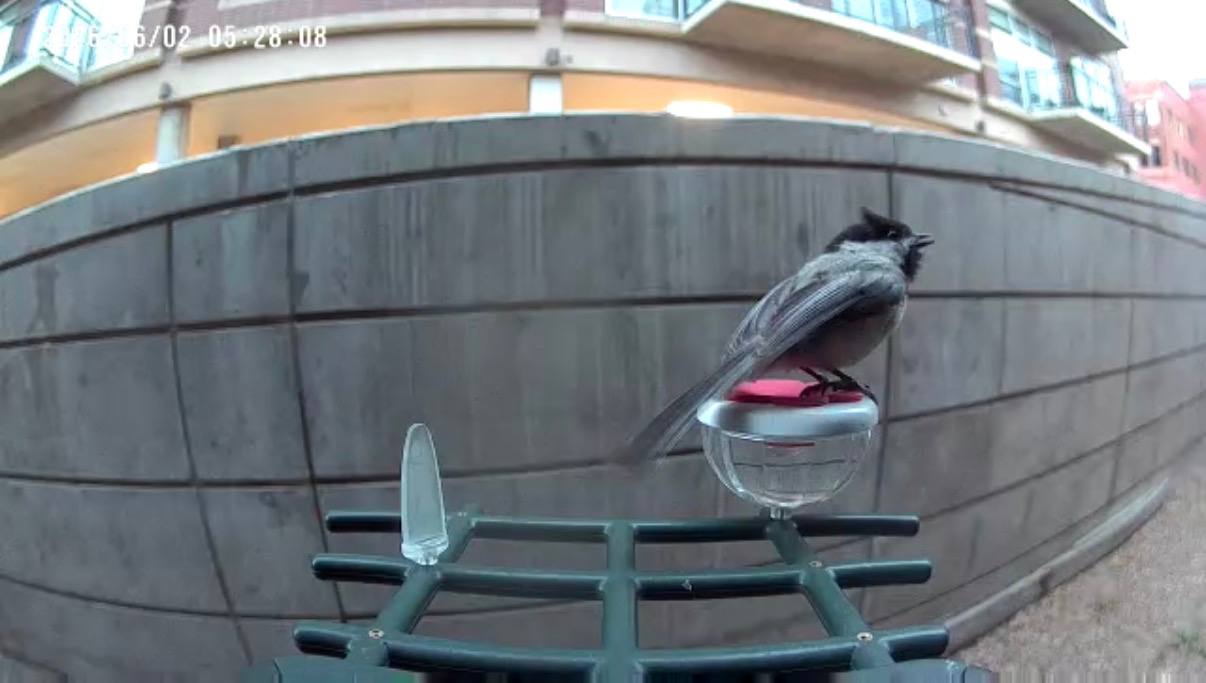
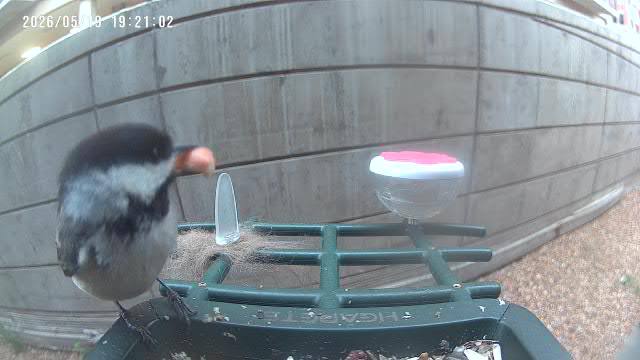
Years later, a chickadee turned up at her feeder in Denver. She'd been calling it 'elusive,' trying new seed to coax one in — and then found one had already visited weeks earlier, hiding in a photo she'd scrolled right past. Since then it keeps coming back: May 31, June 2, each time to a feeder she'd emptied and bleach-cleaned during a disease-break, each time the first bird of the day.
It's the same species she fed on Toronto Island as a girl — same black cap, same white cheeks. The bird that once landed in her hand, come back around, a couple thousand miles and a couple decades later. "I just hope it doesn't forget me," she said. It won't — three empty-feeder visits in a row is a bird that has already chosen her yard.
Tiny: a neat black cap and bib, bright white cheeks, gray back, soft buff sides, and a frosting of pale edges on the folded wing. The clincher against its mountain cousin is the cap — clean black, with no white eyebrow line. The two-note 'fee-bee' whistle (you'll hear it as 'hey, sweetie') seals it.
Chickadees recognize individual human faces and remember who fed them — so one landing on your hand isn't luck, it's a choice. Each fall the memory part of their brain actually swells, then shrinks back in spring: they regrow memory to survive winter, when they've hidden thousands of seeds, one per spot, and have to recall every place. And on freezing nights they turn their own thermostat down, dropping into a controlled overnight chill just to make it to morning. (Their 'chick-a-dee-dee' call is an alarm code, too — more 'dees' means a smaller, scarier predator.)
-
Jun 2, 2026 · 5:28 AM
The first bird of the day, singing its two-note 'fee-bee' with the crown raised. Three returns running now.
-
May 31, 2026 · 6:17 PM
Came back and posed dead-center on the cam, staring down the lens — but the feeder was empty, mid-cleaning.
-
May 19, 2026 · 7:21 PM · found later in the photos
The very first visit — found weeks later, scrolling back through the feeder photos.
- the morning the chickadee sang · Jun 2